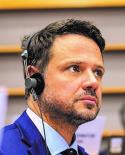
The Commission for the Environment, Climate Change and Energy has adopted an opinion led by Rapporteur Rafał Trzaskowski (PL/EPP), Mayor of Warsaw, calling for a stronger, more territorially anchored Multiannual Financial Framework (MFF).
In his intervention, Trzaskowski stressed that climate investment is inseparable from Europe’s security and competitiveness, highlighting the EU’s continued vulnerability to fossil fuel dependency and price shocks. He underlined the essential role of regions and cities in delivering the green transition, warned against centralising funding through single national plans, and called for preserving cohesion policy, ensuring multi-level governance, and maintaining dedicated instruments such as the LIFE programme. He also emphasised that without meaningful involvement of local authorities, the EU risks failing to meet its climate spending targets and weakening its overall policy delivery.
Highlighting the importance of empowering cities, Trzaskowski pointed to the need for more direct support at local level, noting that targeted funding can accelerate innovation and implementation. As he put it, “Direct funding drives innovation. It encourages strong pilot projects. It also strengthens democracy, because money goes directly to local and regional authorities that are closest to citizens and often more resilient to populism.”
The opinion sets out clear proposals for the next MFF. It calls for preserving a strong cohesion policy that guarantees accessible funding for all local and regional authorities across Europe. It emphasises that investments in regions and cities are critical to delivering sustainable energy systems and the circular economy on the ground. While welcoming the 43% climate and environment spending target in National and Regional Partnership Plans, it stresses that achieving this objective requires strong territorial ownership, given that most mitigation, adaptation and nature restoration measures are implemented locally.
At the same time, the opinion warns that replicating a “single national plan per Member State” model risks greenwashing, undermining the effectiveness of EU climate action and increasing territorial disparities. It also calls on the European Commission to strengthen capacity-building support for all levels of governance—especially local and regional authorities—during the remainder of the current programming period to accelerate the green transition.
Overall, the opinion argues that Europe’s ability to meet its climate, competitiveness and security objectives will depend on fully engaging cities and regions, and ensuring they have both the resources and the governance role needed to act effectively.
Asa Ågren Wikström, Regional Councillor of Västerbotten Region, highlighted the importance of ensuring that the EU budget is both accessible and effective for those delivering the transition on the ground, stressing that it should be “easily accessible and directly targeted to local and regional authorities.” She also underlined that public funding alone will not suffice, calling for stronger mechanisms to mobilise private investment at scale. Drawing on Sweden’s experience, she pointed to the key role of local and regional authorities in phasing out fossil energy, while noting that the next major challenge lies in supporting industry’s transition in hard-to-abate sectors such as steel, fuels and concrete. She raised key questions about how the MFF can better link the clean transition with competitiveness, and what risks the current proposal poses for financing local-level action.
Hanna Zdanowska, Mayor of Łódź stressed that local and regional authorities must be fully involved in shaping and implementing the green transition, warning that for many communities “this is a question of survival.” She emphasised the need to focus on effective and fair implementation, cautioning that fragmented approaches and siloed decision-making could lead to missed opportunities. She concluded that without giving local authorities a real role, Europe risks falling short of its ambitions, underlining that cooperation across all levels of governance “is not optional — it is essential.”